Vision-led planning is appealing, but it might not be the vision we envisaged

I have a confession that might make me unpopular among fellow sustainable transport practitioners. I don't love the term 'vision-led planning'. I probably want the same things that vision-led promoters want, but I don't like the idea of "let me tell you about a great vision, trust me, you would love it". I'd much rather we used good old numbers and evidence to convince the public that our proposals are desirable (us being those who want to see more sustainable transport). It's not like we're missing the evidence; we have plenty of examples where sustainable planning worked, and is working.
I know (I think) that promoters of vision-led planning don't mean it to be unsubstantiated. But then why do we need the word vision? Vision is about imagining the unseeable. "She is a visionary" would normally mean that she sees what others don't. But sustainable planning and transport are perfectly visible. We need to do very little imagining to see how more of it could be done. So why not use the word plan? A plan is a series of steps that would result in a predictable outcome. The rationale and assumptions behind each step can be questioned, validated, and adjusted, to ensure the outcome is achieved.
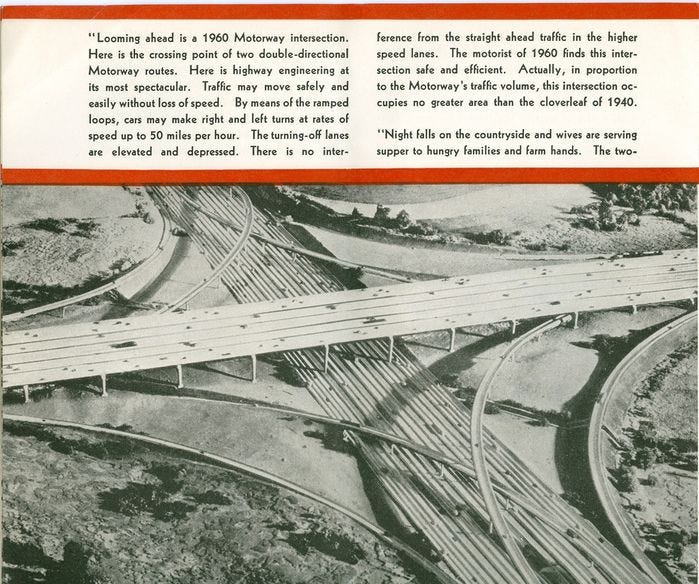
Personally, I get suspicious when someone is trying to sell me a vision. Some people might find it uninspiring, but there is a good reason to be suspicious. We are currently in this state of wasteful and unsustainable reliance on private cars because of someone's vision. The motorway intersection in this picture might not look unique today, but in 1939 it was 'a vision' for 1960. It was the vision of General Motors who presented at the 1939 New York World's Fair as part of the Futurama exhibition. Unfortunately, General Motors was successful in promoting their vision because politicians, civil servants and the public allowed it to go unchecked. After WWII, almost every developed country in the world embarked on massive road building projects. These projects went ahead with poor analysis of the impacts, destroying swaths of countryside and (literally) demolishing wealth in cities.
It is clear today that traffic can't go "easily without loss of speed" as the advert promises because it's too congested when you most need it. And it's not something you couldn't work out back in 1939; you could if you bothered to try, but most people didn't. They liked the vision too much.
Vision is important to inspire and to show what's possible. But when it comes to policy making and spending public resources, I think it's much better to stick to boring evidence, analysis and plans, and call it for what it is.
(Images via David Levine on Flickr)